Cordless ratchets compared: drive size, torque and speed side by side
You spend time under a hood or behind an appliance running nuts and bolts on and off, and a cordless ratchet would save the cranking. Which drive size, how much torque and how much speed do you need, and which platform's ratchet fits the batteries you have? This page compares six current models on those figures.
What we compared and why
- Drive size. The drive has to match your sockets. 3/8 in. covers most car and appliance fasteners; 1/4 in. suits small fasteners; 1/2 in. takes larger sockets. A ratchet with interchangeable anvils covers more than one.
- Listed torque. A cordless ratchet runs fasteners down and spins them off once they are loose; it is not meant to break loose a stuck bolt. We read the maker's maximum torque in ft-lb and treat a higher figure as more margin before you finish by hand.
- Speed (RPM). Speed is how quickly a long bolt spins off. Read it beside the torque figure: two ratchets can list the same torque at very different speeds, as Milwaukee's two M12 models in this table do.
- Battery platform and what comes in the box. Most of these are sold as a tool only, with no battery or charger. If you already own batteries for one platform, its ratchet uses the batteries you already own; if not, a kit or a USB-charged tool may make more sense.
The models compared
| Model | Platform | Drive or chuck size | Max torque (as listed) | Speed | Brushless named | Sold as |
|---|---|---|---|---|---|---|
| Milwaukee M12 3/8 in. ratchet (2457-20) | M12 | 3/8" | 35 ft-lb | 250 RPM | Not stated in listing | Tool only |
| Milwaukee M12 FUEL 3/8 in. high-speed ratchet (2567-20) | Milwaukee M12* | 3/8" | 35 ft-lb* | 450 RPM* | Yes | Not stated in listing |
| DEWALT 20V MAX XR 3/8 in. and 1/2 in. sealed-head ratchet (DCF510B) | 20V MAX | 3/8" and 1/2" | 75 ft-lb | 300 RPM* | Yes | Tool only |
| DEWALT ATOMIC 20V MAX 3/8 in. ratchet (DCF513B) | 20V MAX | 3/8" | 70 ft-lb | Not stated in listing | Yes | Tool only |
| CRAFTSMAN V20 multi-size ratchet, 1/4 in., 3/8 in. and 1/2 in. (CMCF935B) | V20 | 1/4" and 3/8" and 1/2" | 40 ft-lb | 300 RPM | Not stated in listing | Not stated in listing |
| VESSEL slim electric ratchet, 1/4 in. hex drive (400ER3) | Not stated in listing | 1/4" | Not stated in listing | 400 RPM | Not stated in listing | Not stated in listing |
Table values are read from each product's current Amazon listing at the time of this page's build and normalised to one unit by us. "Not stated in listing" means the listing does not give the figure; "Listing gives two values" means the listing states it two different ways, so we show neither. Values marked * come from the maker's own spec page, linked under Sources.
We earn a commission if you buy through the Amazon links on this page, at no extra cost to you. Commissions never decide which products are listed or how they are described.
Milwaukee M12 3/8 in. ratchet (2457-20)

Who it fits: M12 owners who want a compact 3/8 in. ratchet for running fasteners on and off; Milwaukee gives it up to 35 ft-lb and 250 RPM.
Skip it if: You want more torque before finishing by hand; the DEWALT rows in this table list about twice as much.
Milwaukee M12 FUEL 3/8 in. high-speed ratchet (2567-20)

Who it fits: M12 owners who spin off long bolts and want the highest speed in this table, 450 RPM per Milwaukee.
Skip it if: You want more than the 35 ft-lb Milwaukee lists; this one gives speed, not extra torque.
DEWALT 20V MAX XR 3/8 in. and 1/2 in. sealed-head ratchet (DCF510B)
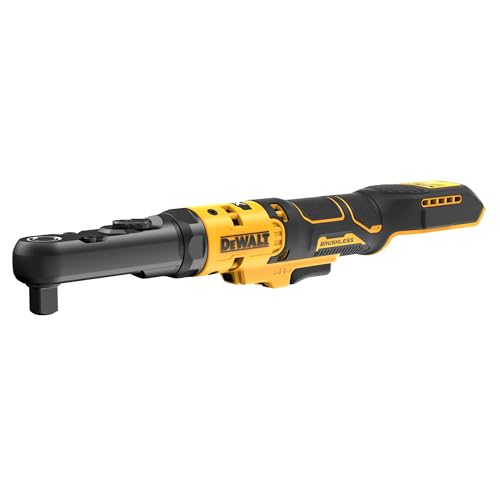
Who it fits: DEWALT 20V MAX owners who use both 3/8 in. and 1/2 in. sockets; it lists the highest torque in this table and swaps anvils between the two drives.
Skip it if: Most of your work is in tight spaces with small fasteners; a 1/4 in. or compact 3/8 in. tool is shorter.
DEWALT ATOMIC 20V MAX 3/8 in. ratchet (DCF513B)

Who it fits: DEWALT 20V MAX owners who want a 3/8 in. ratchet with torque close to the DCF510B's, in DEWALT's compact ATOMIC line.
Skip it if: You also use 1/2 in. sockets without an adapter; the DCF510B takes both drives.
CRAFTSMAN V20 multi-size ratchet, 1/4 in., 3/8 in. and 1/2 in. (CMCF935B)

Who it fits: CRAFTSMAN V20 owners who want one ratchet for three socket drive sizes, with 40 ft-lb and 300 RPM listed.
Skip it if: You need more torque than the 40 ft-lb listed; the DEWALT rows list more.
VESSEL slim electric ratchet, 1/4 in. hex drive (400ER3)

Who it fits: Small fasteners in tight spots where you want a slim, USB-charged tool with no battery platform to buy into.
Skip it if: You need motor torque to run nuts down: VESSEL gives its electric output as 1 N·m, with manual tightening up to 60 N·m by hand.
What a cordless ratchet is for
A cordless ratchet replaces the cranking, not the breaker bar. You loosen a tight bolt by hand, then let the motor spin it off; you run the nut down with the motor, then finish it by hand or with a torque wrench. None of these is a torque wrench: when a fastener has a specified tightening value, a torque wrench sets it. So the figures that matter are the ones in this table: the drive that fits your sockets, how much torque the motor gives before you take over by hand, and how fast it spins. This comparison is research-based, from the current listings and the makers' spec pages; we have not used these tools ourselves.
Torque and speed: read both
Milwaukee's two M12 models here list the same 35 ft-lb; the 2567-20 is the high-speed one at 450 RPM against the 2457-20's 250 RPM. Torque alone would not tell them apart, so decide which figure your work leans on:
- If you mostly spin off long bolts that are already loose (exhaust hangers, brackets, long engine bolts), weight speed.
- If you mostly run nuts down until they seat, weight torque: the more torque the motor gives, the less you finish by hand.
- If you do both, a mid-speed tool with more torque, such as the two DEWALT 20V models, covers more of the job before you reach for the hand ratchet.
Drive size and your sockets
Three of the six ratchets here are 3/8 in. only. The DEWALT DCF510B takes 3/8 in. and 1/2 in. on interchangeable anvils, and the CRAFTSMAN CMCF935B comes with anvils for 1/4 in., 3/8 in. and 1/2 in., according to their makers' pages. The VESSEL takes 1/4 in. hex bits and sockets; VESSEL's page lists a 1/4 in. hex to 3/8 in. square adapter in the box. If your socket set is mostly 3/8 in., any of them works; if you also own 1/2 in. sockets, the two multi-drive tools save you an adapter.
How the torque figures line up
Read top to bottom, the listed torque figures fall into three groups:
| Group | Models | Listed torque |
|---|---|---|
| Higher | DEWALT DCF510B, DEWALT DCF513B | 75 and 70 ft-lb |
| Middle | CRAFTSMAN CMCF935B | 40 ft-lb |
| Lower | Milwaukee 2457-20, Milwaukee 2567-20 | 35 ft-lb each |
The VESSEL is a different kind of tool. VESSEL states 1 N·m of electric output, which is under 1 ft-lb, and up to 60 N·m when you turn it by hand; it is an electric screwdriver-style spinner in a ratchet body, not a motor that seats nuts. Our page on torque units explains how N·m and ft-lb convert.
Which one if...
- You own Milwaukee M12 batteries: the 2457-20 for general work, the 2567-20 if speed on long bolts matters more.
- You own DEWALT 20V MAX batteries: the DCF510B if you also use 1/2 in. sockets, the DCF513B if 3/8 in. covers your sockets.
- You own CRAFTSMAN V20 batteries: the CMCF935B, the only one here with anvils for three drive sizes.
- You own no battery platform and work on small fasteners: the VESSEL charges over USB-C and needs no battery system.
What this page does not tell you
We do not measure head size, length or how the tools fit in a given engine bay, and we do not rank them. Torque figures are each maker's own; makers do not all measure them the same way, so treat small differences as a tie. For the tightening torque of any fastener, use the figure in your vehicle's or appliance's service manual and a torque wrench.
Sources
- Milwaukee M12 3/8 in. ratchet 2457-20 product page (milwaukeetool.com)
- Milwaukee M12 FUEL 3/8 in. high speed ratchet 2567-20 product page (milwaukeetool.com)
- DEWALT 20V XR brushless 3/8 in. and 1/2 in. sealed head ratchet DCF510B product page (dewalt.com)
- DEWALT ATOMIC 20V MAX brushless 3/8 in. ratchet DCF513B product page (dewalt.com)
- CRAFTSMAN V20 multi-size ratchet CMCF935B product page (craftsman.com)
- VESSEL electric slim ratchet No.400ER3 product page, in Japanese (vessel.co.jp)